![Trint_Logo-no-padding.png]](https://info.trint.com/hs-fs/hubfs/Trint_Logo-no-padding.png?height=40&name=Trint_Logo-no-padding.png)
Updated over a week ago
Realtime transcription allows you to transcribe livestreams of events as they happen, and give colleagues access to an editable text version in as fast as three seconds. They can start working on it as the event happens and publish within seconds of words being spoken.
This guide will explain how to set up your live feed in Trint, or via API, and share transcribed content with your team instantaneously.
This support guide will cover:
Creating a Realtime Transcription from a Live Stream
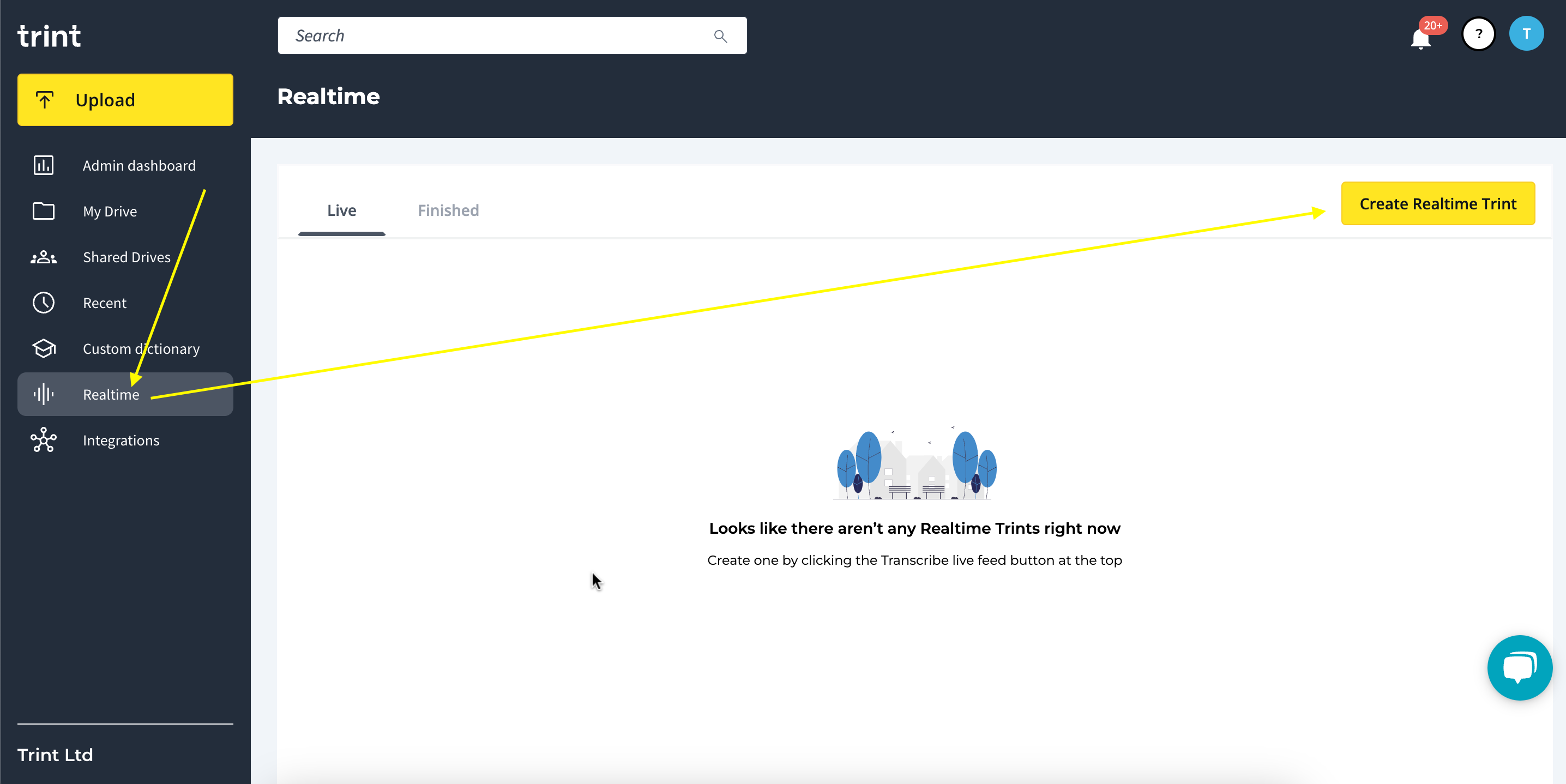
Log in to your Trint account and select the “Realtime” category down the left-hand sidebar of the Trint dashboard. Now click on “Create Realtime Trint” in the navigation bar at the top of your browser.
Using pull and push protocols
Realtime transcription can accept both pull and push streams. With pull, Trint connects to your feed. With push, your streaming software sends the feed to Trint.
Select the "Capture live stream" option you need and the streaming protocol (RTMP/HLS or SRT), then input your feed URL to set up the connection.

Pull feeds can be any FFmpeg protocol format, including common protocols like RTMP, HLS, Icecast and MPEG-DASH, as well as SRT. A full list of FFmpeg protocols can be found here. For RTMP, HLS and other non-SRT feeds, choose RTMP as the streaming protocol.
Push feeds can be RTMP or SRT. Please contact your Trint account manager to discuss any other protocols not covered.
SRT
SRT (Secure Reliable Transport) is a live streaming protocol used by many broadcasters. It copes better with unstable connections and can be encrypted. (This is the streaming protocol, not .srt subtitle files.)
SRT pull: Set your encoder to listener mode on a public address and start it before you create the stream in Trint. Then paste its address, for example srt://your-address:9000.
If your stream is encrypted, add your passphrase: srt://your-address:9000?passphrase=yourpassphrase.
The passphrase must be at least 10 characters.
Your firewall must allow incoming UDP traffic on that port from Trint's IP addresses:
US: 34.226.29.191, 18.235.142.22, 35.171.70.135, 54.160.148.155, 100.24.100.114, 100.24.140.182
EU: 34.250.6.73, 34.246.212.82, 18.200.32.9
If Trint can't connect to your stream within 10 minutes, it stops trying.
SRT push: Trint will generate a URL and Stream Key that can be inputted into your streaming software before starting the broadcast. For SRT, Trint generates a single stream URL and a passphrase instead: paste the whole URL into your encoder as it is, and the passphrase too if your encoder has a separate field for it. Broadcasting must begin within 10 minutes of generating this stream key or URL, otherwise it will expire.
If an SRT stream drops and comes back within 10 minutes, Trint carries on in the same transcript.
Customizing your live stream
Next you can customize your stream by selecting the language, time zone and transcription accuracy/time delay.
Bringing the slider to immediate will lower the accuracy of the transcript but populate words up to three seconds after each spoken word. Raising it to maximum will do the opposite – give you a more accurate transcription but take longer to populate the text.
Available languages
| A-C | D-G | H-L |
|
|
|
| M-R | S-T | U-Z |
|
|
|
Multi-language transcription is not yet available for SRT streams.
Accessing the Realtime Transcription
Once you have started broadcasting, the Realtime transcription can be shared with your team and accessible through the Trint app. The transcription can be stopped at any time and will be capped at six hours.
Using the API
You can also create, check and stop Realtime transcriptions with the Trint API. See the Realtime API documentation here.
We hope you have found this article useful. If you have any questions, please reach out to us at support@trint.com and our Customer Support Team will be happy to help.
Related support guides: